
-remove-background_edited_pn.png)
When Times Are Hard: Small Resources That Help Us Carry Big Things

We are living through a difficult time.
Many people are tired, stretched thin, and carrying a lot. There are worries about the war, disruptions to normal routines, the emotional weight of trying to keep our families steady while we ourselves are also feeling the strain.
During times like this, we often wish someone would hand us a clear roadmap for how to get through it.
I don’t have a perfect roadmap. But I do want to share a few ideas that have helped me and many others navigate difficult seasons.
Some of these ideas come from trauma psychology, some from lived experience, and some from the deep wisdom of our tradition.
It Will Pass. Just Don’t Do Anything Stupid.
A number of years ago, during a difficult time in my life, I bumped into a dear friend who is also a rebbetzin. I was overwhelmed and didn’t know how things were going to work themselves out. She asked how I was doing. The answer came with tears. "It's really hard right now. Really hard. What do I do when it's this hard??"
She listened quietly for a while and then said something very simple.
She said: “It will pass. Whatever you do, just make sure you don’t do anything that you’ll regret later.”
At the time it almost sounded too simple. But the longer I’ve lived, the more I’ve come to appreciate the wisdom of that sentence - some of best advice I've ever gotten.
When life becomes very hard, when we feel exhausted, overwhelmed and stretched thin, our job is not always to fix everything immediately.
Sometimes the most important thing is simply to hold steady, take care of ourselves and the people around us as best we can, and avoid making choices that will create bigger problems later.
This moment will pass.
And until it does, we do what we can to carry it. What Creates Trauma?
Many people think trauma is simply about bad things that happen to us.
But trauma is not only about what happened. It is also about the relationship between what happened and the resources available to meet it.
The more overwhelming the stress, and the fewer the emotional, physical, relational, and spiritual resources available, the greater the trauma impact is likely to be.
And the reverse is also true: even when something very painful happens, strong resources can soften, buffer, and help metabolize the impact.
So trauma is not only about the size of the event.
It is about the relationship between the load we are carrying and the support available to help us carry it.

The Same Event Can Land Very Differently
Because trauma depends on this relationship between load and resources, the same kind of event can affect two people very differently.
Imagine a child who is embarrassed by a teacher in front of the class. On the surface it may seem like a relatively small incident.
But if that child is already feeling alone, unsupported, and unsure of themselves, if there isn’t anyone helping them process what happened - that moment can sink deeply into their system. It can become a story about shame, worthlessness, or not belonging. Without enough resources around it, even a small moment can leave a lasting imprint.
Now imagine a different situation.
Someone goes through a much more frightening and objectively difficult experience. But afterward they are surrounded by strong resources: people who love them, a community that supports them, opportunities to talk about what happened, emotional tools that help regulate the nervous system, spiritual meaning, faith, and connection.
Instead of being left alone with the experience, they are held while they process it.
In some cases, people even emerge from difficult experiences with greater depth, connection, and purpose than before. Psychologists sometimes refer to this as post-traumatic growth.
We have seen glimpses of this even among some of the recently released chatufim. The suffering they endured was unimaginable. Yet some of them speak about the strength they drew from faith, from thinking about their families, and from the knowledge that the Jewish people were holding them in their hearts.
None of this erases the trauma they experienced. But strong internal and external resources can profoundly influence how an experience is carried and integrated afterward.
The point is not that suffering is good.
The point is that resources matter enormously.
When the Scale Tips Toward the Challenges
There are seasons in life when the challenges simply pile up.
War. Uncertainty. Exhaustion. Family stress. Disrupted routines.
And sometimes in those moments, the resources available to us feel very small.
Maybe we are tired. Maybe we feel alone. Maybe we have very little time to rest or recover.
When the challenges outweigh the resources, the nervous system goes into survival mode.
People may feel overwhelmed, reactive, shut down, or stretched beyond their capacity.

Growing the Resource Side
The hopeful part of this framework is that while we cannot always control the challenges around us, we can often influence the resources we bring to meet them.
Sometimes resilience does not come from eliminating the difficulty.
Sometimes it comes from strengthening the resources that help us carry it.
Connection. Compassion. Rest. Emunah. Movement. Small routines that give us a sense of structure and control. Creative outlets. Moments of joy.
When resources grow stronger, the balance begins to shift.

Why Different Things Trigger Different People
Another important piece to understand is that difficult times often activate older sensitive places inside us.
Two people can be living through the exact same external circumstances, and yet the hardest part of the experience may be completely different for each of them.
For someone whose early life involved a lot of loneliness or isolation, the most painful part of a difficult season may be feeling cut off from friends or community.
For someone whose childhood involved a lot of uncertainty or instability, the hardest part may be the not knowing - not knowing when this will end, what will happen next, or how things will turn out.
For someone who learned early in life that they had to hold everything together for everyone else, the most overwhelming part may be the feeling of responsibility, trying to keep the household steady while carrying their own worries at the same time.
And for someone whose nervous system learned to expect danger or chaos, sudden alarms, disruptions, or unpredictability may activate a deep sense of alarm in the body.
This is but a small sample of the types of wounds we carry. Each wound and each resonse is unique. When these sensitive places get activated, it doesn’t mean something is wrong with us.
It simply means that the current moment has touched an older place that needs care and compassion.
This may not be the moment to do deep-dive healing work. When we are in the middle of a stressful season, the goal is often stabilization and support rather than trying to resolve everything at once.
But even now, something very meaningful is still possible.
Simply holding our reality with compassion and coherence, acknowledging what is hard while staying connected to our inner and outer resources, can already help the nervous system settle and carry the experience a little more gently.
And that brings us to one of the most powerful resources we have available in moments like this:
The way we respond to ourselves when those tender places get activated.
One surprisingly powerful resource that many of us overlook is the way we speak to ourselves when things are hard.
Let’s try a small experiment.
Think of a recent moment at home when things didn’t go the way you wanted. Maybe you were impatient with a child. Maybe you snapped at someone you care about. Maybe you just felt overwhelmed and not at your best.
Hold that moment in your mind for a second.
Now notice what happens in your body as you remember it. Is there tightness somewhere? A heaviness in your chest or stomach? A sense of contraction?
Now imagine the voice of harsh judgment showing up.
The voice that says things like:
“You should be handling this better.”
“Other people are managing just fine.”
“What’s wrong with you?”
Notice what happens in your body when that voice takes over.
For most people, the body tightens even more. The shoulders curl inward. The breath becomes shallow. The whole system goes into a kind of defensive contraction. It can feel like a crunch-down effect inside, something you want to run away from. Get me out of here.
And when the system feels that kind of internal threat, different protective responses often step in.
Sometimes a protector tries to fight back, irritation, snapping at the kids, anger, blaming someone else.
Sometimes the protector tries to escape, reaching for food, scrolling endlessly, distracting ourselves, numbing out.
Sometimes it shuts everything down, withdrawing, going quiet, feeling emotionally flat.
These responses are not signs that we are broken.
They are the nervous system’s protective attempts to get us out of pain.
The problem is that when the system stays stuck in that defensive state, it becomes harder to think clearly, regulate emotions, or respond in the way we actually want to.
Now try something different.
Go back to that same moment in your mind - the challenging moment at home when things didn’t go the way you wanted.
Take a slow breath.
And now imagine speaking to yourself with deep compassion instead.
You might say something like:
“It’s really not easy to be me right now.”
“I’m carrying a lot.”
“This moment is hard, and I’m doing the best I can.”
Or simply:
“This is a really hard moment.”
Let yourself hold that moment with kindness instead of judgment.
Now pause and notice what happens in your body.
For many people, something shifts. The breath deepens a little. The shoulders soften. There is a small sense of space where there was tightness before. More of an internal message that says:
"This is hard, but I can handle it".
From a neuroscience perspective, something important is happening here.
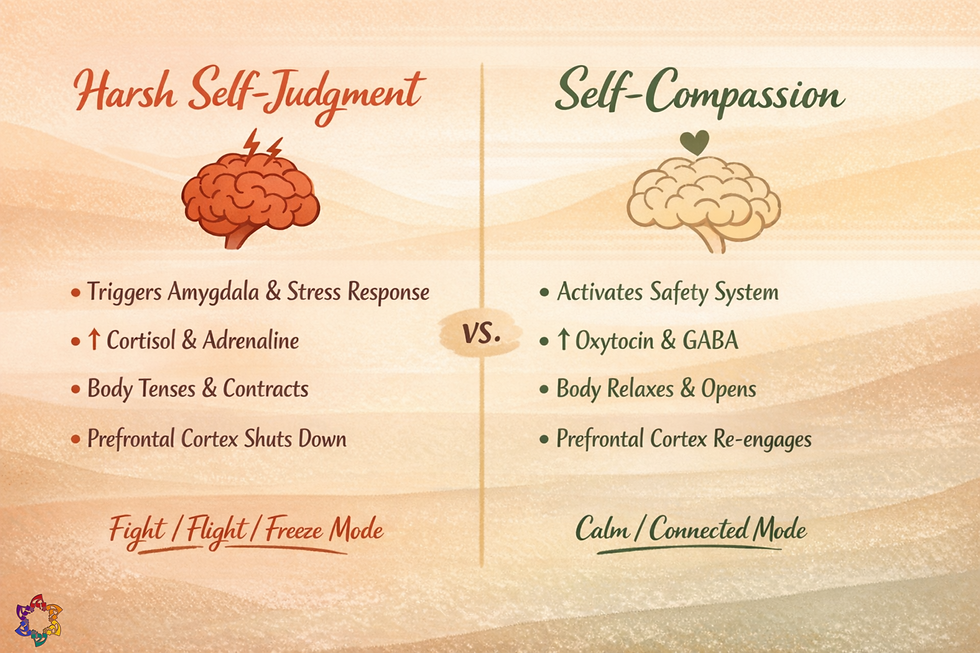
Harsh self-judgment activates the brain’s threat system, including the amygdala. The amygdala doesn't really differentiate between a threat coming from the outside, and one coming from your own cricial voice. The response is the same. Stress hormones such as cortisol and adrenaline increase, preparing the body to fight, flee, or shut down.
Compassion, on the other hand, activates the brain’s soothing and safety systems. The parasympathetic nervous system becomes more engaged, and calming chemistry such as oxytocin and GABA helps the body settle. Sometimes you can almost feel the waterfall of friendly neuro-chemicals wash down through your body.
In other words, compassion is not indulgence.
It is a powerful way of helping the nervous system regulate itself. (Regardless of whether or not you believe you deserve it!) And that regulation becomes a resource! One that we can carry with us wherever we go.
Growing the Resource Side in Everyday Life
If trauma impact is shaped by the relationship between the load we are carrying and the resources available to help us carry it, then one of the most hopeful things we can do is to intentionally grow the resource side of the scale.
The good news is that resources do not have to be big or dramatic to matter.
In fact, during stressful seasons it is often the small, steady resources that help the nervous system the most.
A kind sentence.
A few slow breaths.
A supportive conversation.
A short walk outside.
A moment of connected, heartfelt prayer.
A small routine that reminds the body that life still has structure and rhythm.
Each of these may seem small on its own. But in little tiny cumulative bits, together they begin to shift the balance.
They help the nervous system move out of survival mode and back toward a sense of safety, connection, and regulation.
Here are some small resources that many people find helpful during hard days. Pick one or two that could be supportive to you.

Choose Small, Sustainable Goals
When life becomes difficult, our instinct is often to try to regain control by doing something big and dramatic.
We make large plans. We try to fix everything at once. We push ourselves to suddenly become the best version of ourselves.
But in times like these, that approach often backfires.
Instead, it is usually wiser to choose very small, sustainable goals.
Maybe today the goal is simply:
to say one kind sentence to each member of the family
to step outside for a few minutes of fresh air
to drink enough water
to send a supportive message to a friend
Tiny resources, repeated consistently, slowly strengthen the system that carries us through difficult seasons.
Protecting the Resources We Have
Another way to protect the balance is to be thoughtful about what we take into our system.
There are things we cannot control. If a siren goes off outside the window, we will hear it.
But we do have some influence over how much distressing information we absorb throughout the day.
Constant news updates, endless scrolling, and exposure to upsetting information can quickly overwhelm the nervous system.
Sometimes an important resource is simply creating gentle boundaries around what we take in, allowing our system moments of rest and recovery.
So even in difficult seasons, we are not completely powerless. We can influence the balance - both by being thoughtful about what we take in, and by adding small experiences that nourish and support us.
All of this brings me back to the simple wisdom my Rebbetzin friend shared with me during a difficult time in my own life, that hard seasons eventually pass, and in the meantime our job is often simply to hold as steady as we can, and avoid making choices we will regret later.
There is a story told in Breslov about a man walking down the street carrying many things. In one arm he holds his tallis and tefillin bag. In the other, a stack of sefarim. As he walks quickly, one of the clips on his suspenders pops loose. He keeps going, hoping he’ll reach his destination before things fall apart.
Then the second clip pops loose.
Now he realizes he is in real trouble.
Rebbe Nachman tells the story and then asks: “So what do you think happened to the man?”

And then he answers:
“I don’t know. But one thing is certain - he’s not still standing there!”
Life keeps moving.
Somehow we find our way forward.

“This too shall pass…”
Shalvi, as usual that was so clearly and beautifully written. Thank you for generously sharing such a valuable resource. I am sure it will help many people. I especially liked the visuals with the scale. May you continue to use your talents to be a resource for your clients and all of Klal Yisroel , especially in these difficult times.